The next era of digital marketing will be engineered – not managed. By 2030, the leaders in B2B and B2C will be those building agentic growth engines: autonomous, self-learning systems that compound their own insights and outcomes, delivering continuously improving performance and sharper competitive advantage. Forget the quarterly campaign cycle – agentic systems will transform marketing into a perpetual, data-driven growth machine. For forward-thinking CMOs and founders, the challenge isn’t adopting the latest tool – it’s architecting truly intelligent systems, investing in real-time data, and leading the teams that make AI-enabled growth durable, measurable, and safe.
1. The Great Marketing Reset: Why Agentic Systems Are the Future
Every transformation in marketing – from CRM, analytics, and programmatic buying to AI-powered segmentation – has moved brands from manual orchestration toward scalable automation. But agentic systems, built on autonomous AI, are taking us further: they learn, adapt, and optimize faster than any human-managed workflow ever could.
Imagine a persistent engine running inside your marketing stack – producing high-performing creative, adapting budgets, optimizing audiences, and experimenting with offers, all in real time. This isn’t about automating tasks. It’s about creating compounding feedback loops that drive results across every funnel stage, every hour of the day.
2. How Agentic Marketing Works: Beyond Automation
What makes agentic growth revolutionary isn’t speed – it’s strategic autonomy. Unlike classical marketing automation (campaign triggers, rule-based flows), agentic systems:
Combine generative AI (content/creative/offer generation), predictive models (forecasts of intent, churn, and value), and self-updating decision logic
Operate across all channels simultaneously – learning, reallocating, and optimizing with no human bottlenecks
Turn every interaction, success, or failure into new experiments, instantly accelerating the next cycle
For CMOs and marketing leaders, this means the end of episodic, siloed campaigns. Agentic systems orchestrate perpetual, closed feedback loops, making every customer action part of a living growth strategy.
3. Why Now? The Converging Forces Making Agentic Growth a Reality
Several forces have made autonomous marketing possible—and imperative:
AI Maturity: 65%+ of global enterprises now deploy AI in core functions; modern marketing stacks use advanced models, generative technologies, and real-time signal processing.
Data & Analytics Revolution: With real-time first-party data, agentic engines adapt instantly—no more waiting weeks for static reports.
Efficiency Pressure: Marketing budgets are flat or shrinking globally (7–8% of revenue on average); dynamic agentic systems extract more value from every dollar invested.
Industry Momentum: From ad tech startups to Fortune 500s, the market is moving beyond tools toward full-scope automation, cross-channel orchestration, and AI-powered experimentation.
4. Agentic vs. Traditional: The Strategic Leap
Where traditional automation is reactive, agentic systems are proactive and continuous:
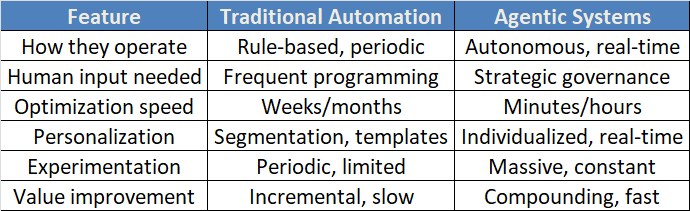
Agentic marketing reduces latency between insight and action – every conversion (or missed opportunity) triggers new experiments, bid strategies, and creative tests. Leading brands are already seeing 15–30% faster innovation cycles and measurable improvements in NPS, CLTV, CAC, and retention.
5. What Agentic Systems Deliver: Business Outcomes That Matter
Agentic systems, built well, unlock impact at every stage:
Acquisition: Agents shift media budgets instantly based on predicted customer value, testing and iterating thousands of micro-variants of creative, audience, and bid. Result: lower cost per acquisition and faster scaling.
Conversion: Offers, journeys, and landing experiences are personalized at the individual level. No more batch templates – every visitor sees the version most likely to convert for them.
Retention & Value: Predictive models trigger interventions – targeted incentives, education, and outreach – measured and optimized in ongoing loops. This leads to significant churn reduction and increased lifetime value.
Revenue Optimization: Agents test dynamic pricing, bundle offers, and upsell strategies, learning what works for different segments and seasons.
Customer Experience: Friction signals are detected in real time; agents coordinate support, recommend products, and trigger in-product help. The result: material increases in satisfaction, advocacy, and long-term equity.
Operational Efficiency: Low-value tasks (reporting, creative adaptation, A/B management) are fully automated, freeing human talent to focus on big-picture strategy and brand building.
6. Architecting the Agentic Marketing Stack
Data Foundation: Build a real-time, first-party data backbone. Stream every interaction and transaction, resolve identities, capture consent.
Model Ecosystem: Develop models for short-term behaviors (session intent) and long-term value (LTV). Use generative AI for creative, causal algorithms for decision-making.
Orchestration & Execution: Design policy engines that let agents act end-to-end – adjust budgets, test creative, coordinate channels. Embed human guardrails: brand safety, compliance, and creative oversight.
Continuous Learning & Governance: Deploy MLOps pipelines for retraining, drift detection, and experiment management. Maintain strong governance: audit trails, HITL controls for risk, fairness, anomaly checks.
Org Structure Shift: Assign new roles: agent designers, AI ethicists, MLOps specialists. Foster a culture of cross-disciplinary teamwork, measurement, and constant iteration.
7. Measurement and Attribution in Agentic Systems
Classic attribution models don’t fit dynamic, self-learning engines. The new rules:
Use causal measurement – randomized holdouts, uplift modeling, and synthetic controls – over correlation and channel attribution.
Optimize for multi-objective outcomes: LTV, revenue, churn, satisfaction, compliance – not just conversions.
Maintain counterfactual logging (what the agent would have done) – for compliance, model review, and further experimentation.
Real-world leaders build dashboards to track “system health,” not just campaign scores. They invest in continuous review and explainability to satisfy auditors and customers alike.
8. Playbook for CMOs, Founders, and Marketing Leaders
Start Here:
Audit & Integrate Data: Stitch together every relevant customer touchpoint and channel.
Build (or Buy) Your Models: Blend predictive, creative, and causal engines.
Pilot Agentic Loops in One Funnel: Onboarding is ideal; measure and iterate.
Implement Governance: Assign human-in-the-loop champions, set escalation and compliance protocols.
Scale Up: Expand to cross-channel orchestration and broader objectives.
Culture & Skill-Building: Upskill teams; align incentives to experimentation and loop velocity.
Success metrics:
80% automation of routine campaign work
+10–15% conversion, CLTV, or retention uplift in pilot domains
Compliance maintained; zero audit failures
9. Risks, Governance, and Leadership Mandate
No technology is risk-free. CMOs and founders must be proactive:
Mitigate bias: In models and outcomes—with regular fairness audits
Prioritize explainability: Every agentic policy must be logged, auditable, and rationalized
Safeguard data privacy and legal compliance: Real-time consent, incident management, regulatory reviewable pipelines
Balance autonomy with human oversight: Brand voice must remain authentic, not robotic
Stay agile: Business objectives shift, so agentic systems must be reviewed, aligned, and updated regularly
10. The Future Outlook: The Compounding Gap and the Race to Self-Evolving Brands
By 2030, agentic orchestration will be standard in high-performing enterprise marketing stacks. The gap between first movers and laggards will widen into a chasm:
Early adopters will deepen competitive moats (data, brand preference, operational leverage)
Regulatory oversight will increase (demanding fairness, privacy, explainability)
New talent blends (AI strategists, creative trainers, ethicists) will define world-class teams
Design systems that learn and compound value. Lead the charge – not as a passive adopter, but as a creator of next-generation marketing strategy. Agentic growth is not just a technology trend – it’s a new way to engineer persistent, compounding commercial advantage in a noisy, complex world. The best results will come from blending AI autonomy with human creativity, ethics, and vision. Those who design these systems today will write the stories of tomorrow’s market leaders.