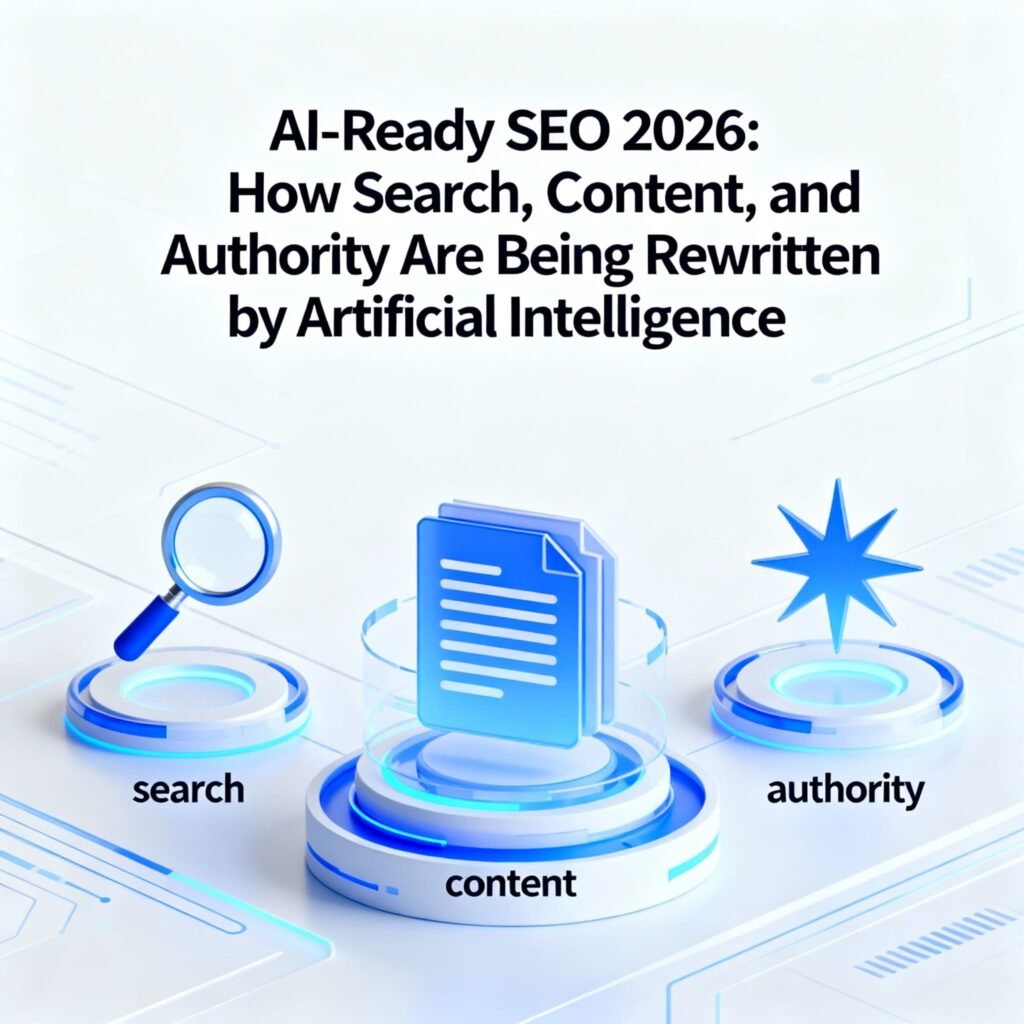
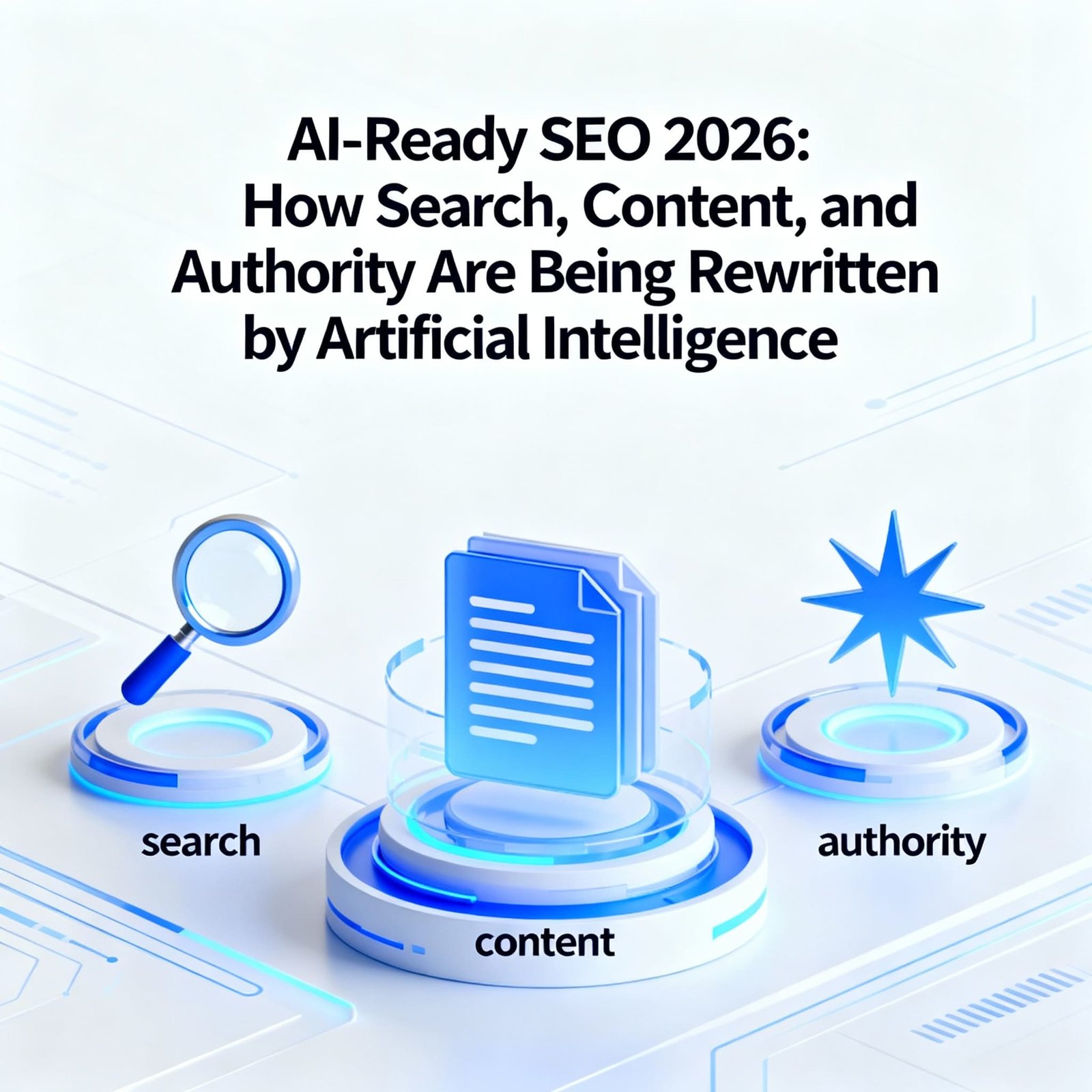
The Great Rewrite of 2026: When Search Stopped Being Search
By 2026, search isn’t what it used to be. The familiar blue links and keyword-based competition that dominated digital marketing for two decades have been quietly replaced by something more invisible, more intelligent, and, for many brands, more threatening. Today, AI systems answer before anyone clicks. They summarize, synthesize, and sometimes even decide on behalf of the user.
This shift means your website – no matter how well-optimized – might never be seen by the human eye if it doesn’t first earn the trust and comprehension of machines. The truth is unsettling: you can rank first and still receive zero traffic. For marketers who built entire growth engines around search visibility, this is an existential pivot.
Yet within every transformation lies an opportunity. Just as the SEO survivors of Panda, Penguin, and RankBrain learned to evolve from link-builders to experience architects, the 2026 generation of marketers must evolve from keyword tacticians to AI-literate brand engineers. The future belongs to those who understand not just how to rank in results, but how to be understood by algorithms.
The question is no longer “How do I optimize for Google?” but “How do I teach AI to trust and represent my brand?” The foundation of AI-Ready SEO lies in this new discipline: making your expertise, authority, and entity-level depth visible, verifiable, and machine-readable.
The Evolution of Search: From Queries to Comprehension
Search began as a matching engine. In the early 2000s, the task was simple – align keywords between what a user typed and what a webpage contained. Then came semantic search, the era of meaning rather than words. Google’s Knowledge Graph, Hummingbird, and RankBrain taught algorithms to infer intent. But 2026 represents an even deeper leap: search has become comprehension.
AI models like Gemini, ChatGPT, and Perplexity don’t just find pages; they digest them. They parse context, weigh trust, and synthesize conclusions the way a human analyst would. Each AI system maintains a dynamic knowledge layer – a constantly evolving web of entities, concepts, and reputational signals.
In this paradigm, optimization means participation. Brands must feed these models accurate, structured, trustworthy data that can be absorbed and cited. Visibility is no longer a ranking; it’s a representation inside an AI’s memory. In short:
SEO is now about training the machines that train your audience.
Traditional metrics – impressions, CTR, even backlinks – are secondary to one emerging KPI: AI visibility. How often is your brand cited, quoted, or referenced by intelligent systems? How often does your content appear in summaries, overviews, or conversational search snippets? The answers to those questions define your future discoverability.
The New Currency of Visibility – From Keywords to Concepts
For years, SEO revolved around targeting keywords with precision – density ratios, LSI lists, and semantic variations. But the era of generative AI has rewritten that logic. Today, keywords are indicators, not determinants. The engines of 2026 rely on entities – people, organizations, topics, technologies, locations – and the web of relationships that connects them.
An entity is a knowledge node. It has attributes, history, credibility, and context. The more your brand or content ecosystem connects to these nodes, the more AI systems perceive you as authoritative within a knowledge domain.
Consider how AI interprets an article about “sustainable fashion.” It no longer scans for “eco-friendly clothing” or “organic cotton.” Instead, it builds a map:
-
Entities: sustainability, textile innovation, slow fashion, environmental impact.
-
Related brands, people, locations.
-
Sentiment and trust context around each node.
When your content consistently intersects with these clusters, AI understands that you’re not repeating a keyword – you’re inhabiting a topic. That is the essence of topical authority.
Building Topical Depth & Semantic Networks
Topical depth is not about writing more – it’s about interconnecting knowledge. A modern SEO strategy in 2026 is structured like a neural network, not a sitemap. You begin with a pillar page – a comprehensive core topic (e.g., “The Future of Digital Sustainability”) – and build supporting nodes: detailed subtopics, case studies, data explainers, and FAQs.
Each node reinforces the parent topic while linking laterally to others, signaling contextual fluency. When AI crawlers encounter this network, they see not scattered posts but an integrated knowledge ecosystem. This network design is what enables entity reinforcement, the new superpower of AI-era content.
Think of it like training a large language model (LLM). You’re feeding the algorithm not just individual documents but coherent systems of meaning. The more consistent and complete your topic graph, the more “confident” the AI becomes about your expertise.
Interlinking as Context Signaling
Internal linking has always been an SEO best practice. In 2026, it’s a semantic necessity. Each hyperlink is a signal of conceptual connection. When crafted intentionally – anchored on meaningful entities – it tells AI models how ideas relate.
For example:
A post about “AI in retail logistics” links to another about “predictive inventory optimization,” which links again to “AI-powered demand forecasting.” That triangular pattern doesn’t just help navigation – it mirrors the associative reasoning pattern AI systems use when clustering knowledge.
A consistent internal linking strategy becomes your brand’s knowledge architecture, shaping how both humans and machines perceive your authority.
Structuring for Comprehension
To thrive in the AI search ecosystem, brands must think like data architects.
-
Map entities before writing. Identify the people, organizations, products, and ideas central to your niche.
-
Use semantic tools. Platforms like Google’s NLP API or SurferSEO reveal entity connections; use them to fill conceptual gaps.
-
Build interconnected clusters. Each content asset should strengthen a network, not stand alone.
-
Use consistent labeling. Headings, schema, and URL structures should mirror your topical map.
In short, design your website as a knowledge graph in miniature. Because in 2026, AI isn’t looking for text – it’s looking for understanding.
E-E-A-T and the Reinvention of Authority
Why Authority Outranks Excellence
Every marketer knows the mantra: “Create great content.” But in the AI search era, great content from an untrusted source is invisible. Machines don’t only ask what was said – they ask who said it, and why they should believe them.
This is the machine version of human psychology. Studies have shown people follow advice from perceived experts even when the message is identical to that of a stranger. AI systems mimic this cognitive bias. They rank and quote sources that exhibit recognized Experience, Expertise, Authoritativeness, and Trustworthiness (E-E-A-T) because it reduces risk – for both the algorithm and the end user.
In 2026, algorithms are designed to minimize misinformation, and their filters prioritize verified credibility. This means average content from a trusted authority will outperform brilliant content from an unknown domain. The hierarchy of trust has become algorithmic.
Author Identity & Real-World Proof
AI doesn’t trust anonymity. Every author or creator must leave a trail of verifiable, real-world proof. That means bios, credentials, and firsthand narratives aren’t optional – they’re ranking signals. When an article about “AI ethics” includes insights from a named data scientist with prior citations on related subjects, AI systems recognize that author as an entity of authority. Over time, this entity accrues “trust weight,” influencing how future content by that author is treated across models.
Author markup, consistent naming conventions, and cross-platform presence now matter as much as backlinks once did. Every digital trace – your LinkedIn activity, podcasts, conference appearances – contributes to your author graph. It’s no longer enough to declare expertise; you must demonstrate it through digital footprints.
Brand Mentions as Modern Backlinks
In traditional SEO, backlinks were votes of confidence. In 2026, brand mentions are citations in the AI web. Whether or not they’re hyperlinked, AI models interpret contextual mentions – news coverage, interviews, partnerships – as reputation signals.
These unlinked citations feed into the brand’s entity reputation. When multiple authoritative domains reference your brand in the same thematic space, the algorithmic confidence increases exponentially.
Therefore, PR, thought leadership, and industry visibility aren’t peripheral – they are the new link-building. The more you appear in credible, relevant contexts, the more you are trusted as a source for summarization and answer generation.
Consistency Across Digital Ecosystems
AI evaluates coherence. If your tone, data, or claims vary drastically between platforms – your website says one thing, LinkedIn another, YouTube something else – the machine perceives inconsistency, which dilutes trust.
Consistency of identity is the invisible layer of modern SEO. Every author name, logo, byline, and data claim should align across your ecosystem. This cross-platform harmony forms what algorithms interpret as a unified authority signature.
The same principle applies to design, metadata, and sentiment. When positive user interactions and engagement metrics reinforce your reputation, AI reads that feedback loop as social proof. Trust is no longer a static credential – it’s a dynamic, data-driven pulse built across every signal of your presence.
The Trust Flywheel: Building Machine-Legible Credibility
The journey from anonymity to authority can be engineered as a process:
-
Define your expertise layer. Identify core topics and align visible subject-matter leaders to each.
-
Codify authorship. Structured bios, schema, and signature patterns in writing style train AI to link content to specific experts.
-
Expand footprint. Guest features, webinars, and quoted mentions across media extend your knowledge reach.
-
Unify identity. Maintain coherence in branding, tone, and positioning across every channel.
Over time, this consistency compounds into what AI perceives as probabilistic trust. In other words, your brand doesn’t just look reliable – it behaves reliably.
Why E-E-A-T Is the Strategic Core of AI Search
E-E-A-T has transcended the checklist mentality. It’s not about adding author bios or citing sources – it’s about architecting a digital reputation system. When users ask AI for insights, the model cites content it perceives as both accurate and safe to endorse. That safety is built on entity reputation – a blend of author identity, brand consistency, and historical reliability.
Therefore, in 2026, E-E-A-T is not a ranking factor – it’s a survival factor. It underpins every citation, summary, and recommendation that AI surfaces. Brands that internalize this shift early will dominate conversational visibility in the years ahead.
Schema & Structured Data: Teaching the Machines How to Read You
Why Schema Has Become the New Language of Trust
In 2026, schema markup is no longer a technical enhancement – it is your site’s grammar in the language of AI. Search and generative systems read schema the way editors read punctuation: to understand relationships, chronology, and hierarchy.
Structured data translates human storytelling into machine comprehension. Whether it’s an organization schema with verifiable founders, a product schema with dimensions and sustainability scores, or a medical article with peer-review references, schema provides a common syntax of truth.
Without it, your content is essentially mute in the AI ecosystem. AI crawlers may still reach your page, but without schema, they can’t understand the depth of entities, the meaning of relationships, or the credibility context behind claims.
The result? You risk invisibility not because your content lacks quality, but because it lacks legibility.
Types of Schema That Dominate 2026
-
Author & Person Schema – Connects content to verifiable human experts, complete with credentials, social profiles, and knowledge graph links.
-
Organization Schema – Defines ownership, brand mission, contact channels, and associated domains, ensuring AI links every asset to the right entity.
-
Product & Service Schema – Encodes attributes like use cases, ingredients, certifications, and sustainability data—essential for ecommerce and B2B.
-
Review & Rating Schema – Now includes sentiment weighting and verified-purchase tagging to combat fake reviews.
-
FAQ & How-To Schema – Powers conversational AI responses; models prefer stepwise, structured data they can repurpose safely.
Each schema type is a mini-API that connects your brand directly into AI systems. The richer your schema, the more “structured surface area” your brand has for discovery.
The Rise of Schema Networks
Forward-thinking brands in 2026 use schema layering – embedding interconnected schema across content hubs so AI can follow relational threads. For instance, a healthcare brand’s “Doctor” schema links to “Treatment” schema, which links to “Research Publication” schema, forming a machine-navigable trust web.
This layered approach doesn’t just help with snippets or featured results; it turns your domain into a verified node within the global knowledge graph. In essence, you’re training AI models to treat your ecosystem as a reliable source.
Content Intelligence: Data-Driven Creativity for the AI Era
From Guesswork to Predictive Publishing
The marketing teams thriving in 2026 have replaced editorial instinct with content intelligence systems. These platforms analyze intent shifts, sentiment dynamics, and query probabilities across generative search environments.
Rather than asking “what’s trending,” they ask “what will be demanded next quarter.” Machine learning models digest data from search patterns, voice queries, and AI chat prompts to forecast topics with precision.
The result is predictive publishing – an editorial calendar that evolves in real time based on signals from the AI ecosystem itself.
Intelligent Content Pipelines
AI-first content workflows operate like production lines of both creativity and compliance:
-
Ideation – Trend intelligence surfaces emerging concepts before they reach mainstream search.
-
Drafting – Generative AI tools build skeletons based on entity maps, not just keywords.
-
Fact-Layering – Human editors inject proprietary insights, ensuring originality and E-E-A-T alignment.
-
Optimization – NLP analysis verifies tone, readability, and semantic density.
-
Feedback Loop – Performance metrics feed back into the model, refining future ideation cycles.
This closed-loop ecosystem ensures every new piece of content is not only optimized for human engagement but also machine-interpretable from inception.
The Human Advantage in an Automated World
Despite automation, the creative edge remains human. AI can mimic tone and structure, but it cannot replicate perspective, lived experience, or emotional authenticity – the very components that E-E-A-T now encodes.
The most effective teams of 2026 follow a “co-creation” model:
-
AI drafts the framework.
-
Humans inject the story, nuance, and ethical voice.
-
Machine analytics refine distribution timing and format.
This hybrid process turns marketers into creative conductors rather than manual producers, orchestrating intelligence at scale without losing humanity.
Experience Optimization: Beyond Clicks and Core Web Vitals
Search Experience Becomes User Experience
Google’s Search Generative Experience (SGE) has blurred the line between discovery and engagement. A user’s first interaction may occur within the AI result itself – summary boxes, conversational snippets, or contextual carousels. Thus, experience optimization in 2026 extends beyond on-page metrics. It encompasses how easily AI systems can reformat your content into these micro-interfaces.
Readable typography, hierarchical headings, concise summaries, and structured reasoning all translate better into AI answer formats. UX design now influences visibility – not just conversion.
Voice, Vision, and Multimodal Optimization
By 2026, multimodal search – text, image, and voice – is mainstream. Optimizing solely for written language is a strategic blind spot.
-
Voice: Craft conversational copy; integrate schema for question-based intent.
-
Visual: Label images with contextual alt text and embedded metadata.
-
Video: Provide chaptered transcripts and entity-tagged subtitles.
Each format feeds a different sensory layer of AI comprehension. The richer your multimodal assets, the stronger your brand’s presence in cross-channel AI search.
Human + AI Collaboration: Redefining the SEO Team
New Roles for a New Era
The marketing department of 2026 doesn’t look like its 2020 counterpart. Traditional SEO analysts are now AI content strategists, knowledge engineers, and entity architects.
-
Knowledge Engineers structure content ecosystems with schema logic.
-
Prompt Strategists train generative systems for tone, context, and brand safety.
-
AI Ethic Officers monitor factual accuracy and source bias.
The intersection of marketing and machine learning has created a hybrid skillset where understanding how AI reasons is as crucial as understanding what customers search for.
The Feedback Loop Between AI and Humans
Smart marketers use AI not just for output but for input. Generative tools analyze brand tone, audience reactions, and competitor authority to reveal unseen opportunities.
Human teams interpret these insights, apply emotional intelligence, and refine creative direction. This symbiotic loop ensures every new campaign improves both the algorithm’s accuracy and the human team’s intuition.
AI Visibility Metrics: Measuring What Matters in 2026
Beyond Rankings and Click-Through Rates
Classic metrics – rank positions, impressions, CTR – only tell part of the story. In AI-first environments, visibility depends on inclusion, citation, and coherence.
-
AI Citation Share – How often your brand or content is referenced by AI systems in summaries or conversational answers.
-
Entity Trust Score – A composite measure of consistency, accuracy, and positive sentiment across data sources.
-
Knowledge Graph Presence – Number and depth of entity nodes representing your brand within public and proprietary graphs.
-
Generative Exposure Rate – Frequency of your content appearing in generative search overviews.
Marketers who track these AI-specific KPIs gain early insight into algorithmic reputation—the new frontier of competitive advantage.
Ethics, Accuracy, and the Responsibility of Influence
When AI Quotes You, It Endorses You
In 2026, being cited by an AI model carries weight. If misinformation originates from your source, the consequences ripple fast. This has pushed ethical SEO into the mainstream. Transparency in data sourcing, factual citations, and bias checks are no longer editorial niceties – they’re survival mechanisms. Brands that uphold integrity not only avoid penalties but also gain preferential trust scoring across models trained on reliability data.
The 2026–27 Outlook: From Optimization to Orchestration
AI Becomes the Interface of Everything
By late 2026, search, recommendation, and interaction systems will converge. Whether through voice assistants, car dashboards, or workplace copilots, AI will be the universal interface to information. To succeed, brands must master orchestration – the ability to synchronize messaging, data, and experience across every AI touchpoint. Optimization alone will no longer suffice.
Your goal is no longer to rank – it is to reside in the AI layer of reality, where machines and humans co-interpret meaning.
Re-Engineering Visibility for an Intelligent World
The AI revolution hasn’t destroyed SEO – it has elevated its purpose. What began as an art of keywords is now a science of comprehension, context, and credibility. In 2026, the brands that lead will not be those with the biggest ad budgets or link farms. They’ll be those that teach AI who they are – clearly, consistently, and ethically.
AI-Ready SEO is not a tactic; it’s a transformation. It demands that marketers become architects of understanding, engineers of trust, and storytellers of truth. The future of visibility belongs to the brands that can bridge human depth with machine precision. And in that balance, the most intelligent brands of 2026 will not merely be found – they will be followed.